…on last week’s post about Porsche and its runaway wheels, Reader Al R. writes:
Regarding why knock-off wheel locks went away, it was the fault of the US Congress. In October 1966 the Department of Transportation was created by it. The new DOT immediately started dictating changes to automobiles to justify its existence. One of the first diktats of the DOT was the outlawing of the Rudge-Whitworth center lock, aka the knock-off.
Since 50% of British sports cars were sold in the USA and it made economic sense to build only one car for all markets the knock-off wheel was no longer provided.
But wait! There’s MOAR! On the topic of Gummint foolishness:
Also in the case of the E-type, the faired headlights were outlawed and the bumpers had to be raised, marring the beauty of the design. The DOT would continue to legislate stupidity with the 5mph bumper law that mandated the ungainly “diving board” bumpers of the ’70s and ’80s. The worst example of this law’s effect was the rubber bumper MGB.
I currently have a 1984 380SL project car that I am restoring and am considering spending about $3,000 (which I don’t have, alas) for Euro headlights and bumpers just because they look so much better than the DOT compliant lights and bumpers. If I don’t scrape up the money from somewhere I’ll have to look at those ungainly bumpers until the day I die.
And I think I should include Reader GT3Ted’s comment from the post, because he knows so much more about cars than I do. First, from Reader Vonz:
“Center-lock wheel bolts and components were manufactured out of specification by a supplier, creating a risk of fracturing and wheel detachment.”
To which Ted replied:
Right, that’s the issue as I understand it as well. A specific batch of 2024 wheel nuts were not properly heat treated or possibly there was a problem with the alloy of Unobtainium they were made from that causes the nut to shatter after a number of heat cycles. When driven aggressively the wheel nut gets very hot.
But rest assured, those wheel nuts on the center lock equipped GT Cars are properly German over-engineered. They need 444 Lb-ft of torque to be properly tightened and new special wheel nut high-temp wheel grease each time they are changed. The nut itself (@ $450.00 each) has an internal locking mechanism that you are supposed to check for proper function after torquing the wheel. The little flap door inside the wheel center is supposed to freely move when pressed, then the wheel center cap goes on making sure that the grove on the cap is aligned with the bump on the wheel so that the pointy part of the Porsche crest is aligned and points to the valve stem.
[Kim’s 25,000-word rant about over-complication deleted]
Now on the race cars like my friend’s 935 that I crewed for, it’s a little different. You just throw the new wheel and tire on, making sure that you start the wheel nut in the correct direction by hand (each side is different) so you don’t cross thread it, then hit it with the nitrogen-powered wheel gun until it stops turning. Release the air jacks and send him back out.
My only comment on the above is a response to this statement: “When driven aggressively the wheel nut gets very hot.”
I can understand the issue if you’re tracking your GT3 RS. I can’t understand that heat problem occurring in typical day-to-day driving. (There are those who can’t understand why anyone would use a GT3 RS for a daily drive, I among them.)
I literally cannot see how the “hot nut” thing could occur in the non-track 718 and 911 models, unless the Unobtanium treatment was really that bad — in which case it’s time Porsche reevaluated their relationship with the supplier.
This, by the way, is one of my problems with the high-performance cars of today: they’re just too much for ordinary drivers (i.e. about 98% of their owners). Engines that can rev at 10,000rpm, engine power that exceeds 600hp, when few people can handle power as low as 300 horsepower. If you want proof of this hypothesis, just do a search on EeeeewwwChoob for stories of wrecked supercars — Lambos, Ferraris, Bugattis and Paganis, most costing in excess of $600,000. (Mat Armstrong repaired one such car which had 57 miles on the odometer: the new owner crashed it on the way home from the dealership.)
I’m not suggesting any kind of Gummint intervention, of course. I just want a little more sanity injected into this market; but I doubt it will ever happen, because there’s just too much Stupid Money around. That bullet has well and truly gone through the church, and there’s no recalling it… more’s the pity.
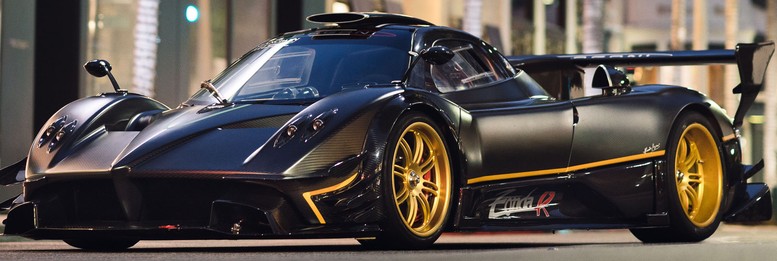
That’s the Pagani Zonda R Evolution [sic]: yours for a measly $6.5 million.
it has a 6-liter AMG engine, putting out 789hp and a top speed in excess of 230mph, and Pagani made only ten (10) of them. Just the thing, then, for a trip to the supermarket, or church, or the range (as long as you’re only shooting handguns — or more realistically, only one handgun).
Except:
“Most Zonda Rs are hidden away in private collections, making public appearances of them exceedingly rare. It’ll certainly sound – and look – way better than any dubiously-shaped billionaire space rocket, that’s for sure.”
Phooey.